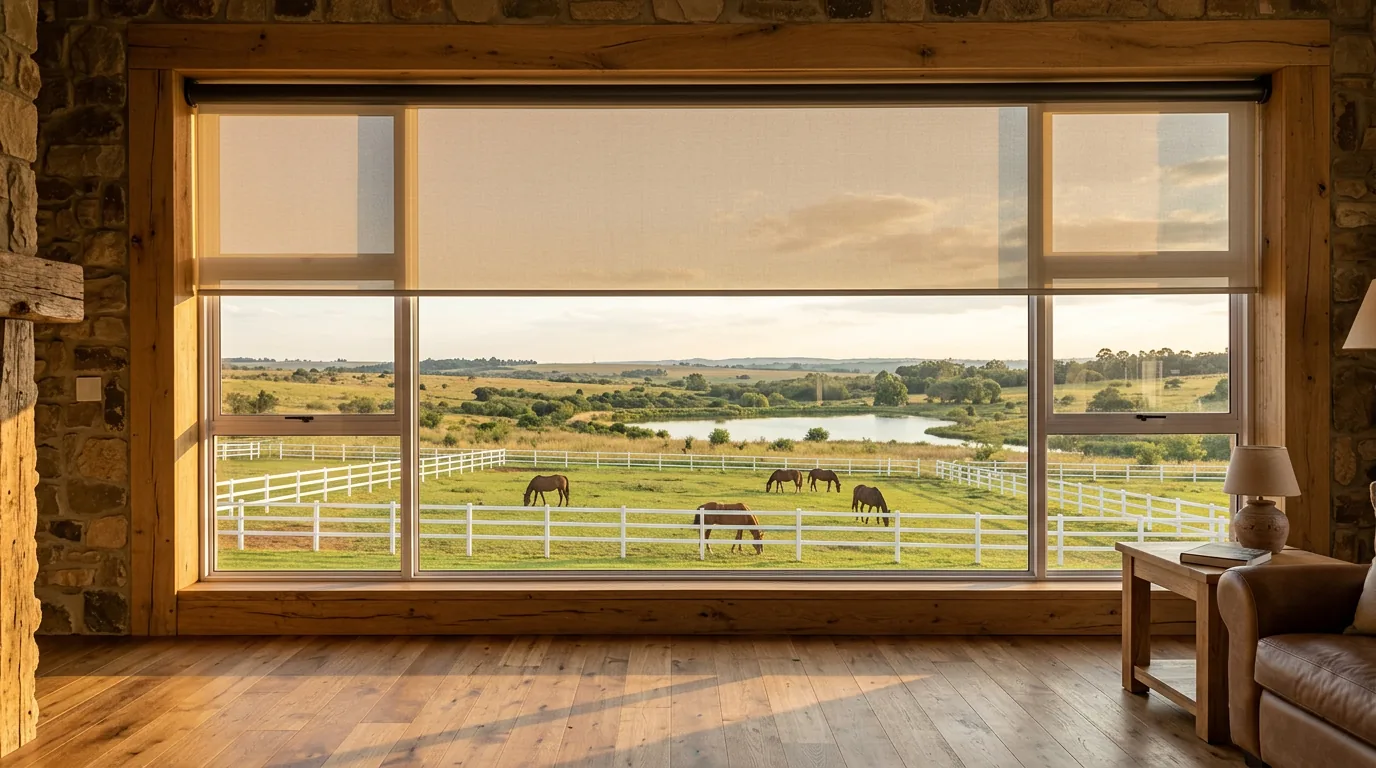
Sunscreen roller blind half lowered over a wide picture window in a Blue Hills estate home, looking out over post-and-rail paddocks and a greenbelt dam

Free to read · Blue Hills, Midrand

The Blue Hills Elevation Report

A window-by-window read on the light up here: what the sun actually does to each face of a Blue Hills house through the year, what we would fit on each one, and what only a visit can settle.

  1. Why a house up here shades differently
  2. The light: 87 degrees in December, 40 in June
  3. Elevation by elevation
  4. What we would fit, and the catch with each
  5. Estate guidelines and older stands
  6. What we would still check on site
  7. The two ways forward
  8. Sources

Where we are

Why a house up here shades differently

Blue Hills sits between Main Road and the N1, north of Sunninghill, perched — as one local guide puts it — on what passes for a hill in Johannesburg. The name comes from the vista those hills make seen from the city, and the Kyalami Country Club runs along the western boundary.

That changes the window brief completely. Blue Hills Equestrian Estate alone covers about 200 hectares, with stands measured in thousands of square metres rather than hundreds, dams and indigenous trees between the houses, and older agricultural-holding properties on large plots all around.

The practical consequence is that nothing borrows you any shade. On an 800 m² suburban stand the neighbour's roof quietly takes the last hour of western sun off your lounge glass. Up here there is a paddock where that roof would have been, so every hour of sun your elevation is entitled to, it gets — and the glass is large, low and pointed straight at the view. The question is almost never "what colour blind": it is which face is being cooked, at what hour, and whether the fix belongs inside the glass or outside it.

The light here

87 degrees in December, 40 in June

East West 21 Dec · 87.5° overhead 21 Jun · 40.6°, due north

Blue Hills sits at latitude 25.95°S, two and a half degrees south of the Tropic of Capricorn. That number explains most of what your windows do.

At midday on 21 December the sun is almost exactly overhead: our calculation for this latitude puts solar noon at roughly 87.5°, against a published 87.7° for Pretoria, twenty-odd kilometres north. On 21 June it noons at about 40.6° and sits due north (Pretoria, 40.84°). So a normal eave shades north glass beautifully at midsummer noon, then lets a long, low beam into the room all winter — free heating, worth thinking about before you block it permanently.

What catches people out is where the sun rises and sets. In December it rises at an azimuth of 116.6° and sets at 243.35° — both well south of the east–west line. It does not politely drop behind the western wall; it swings to the south-west and comes in horizontally, at eye height, at the end of the hottest part of the day.

Two local facts finish the picture. Midrand records roughly 3,211 hours of sunshine a year, and South Africa's latitude, topography and cloudless skies give it high solar ultraviolet — a fabric-fade story as much as a comfort one. And from mid-November to February, Highveld hail peaks between four and five in the afternoon: the same hour your west elevation is at its worst. Heat and hail arrive on the same clock here.

87.5° / 40.6°Solar noon on 21 December against 21 June at this latitude — near-vertical, then low and due north.
3,211 hSunshine hours a year over Midrand, August the sunniest month at about 9.8 hours a day.
28°C / 5°CAn average January afternoon against an average July night — a swing your glazing feels in both directions.

Face by face

Elevation by elevation

Label the four walls with the compass app on your phone before you shop for anything. The right product changes completely between them.

North

Sun all year, and you want most of it

Sun on this face every day: nearly vertical in summer, so a 600–900 mm eave does much of the work, then at 40° and deep into the room in winter. Specify something adjustable, not permanent — you manage this wall differently in January and July.
West

The hard one, every time

By four the room has warmed all day, and the sun arrives low, from the south-west, under every eave you own — glare at eye level, heat direct. This is where stopping it outside the glass earns its cost: interior fabric absorbs the beam and re-radiates it inward.

East

The same geometry, mirrored, at 6am

East glass takes the identical low beam in the morning, but into cool overnight air — so it reads as glare and early waking light rather than heat. That makes it the elevation where an ordinary interior blind, chosen properly, genuinely solves the problem.

South

Soft light, and a different question

South glass sees almost no direct sun most of the year — only a grazing beam very early and very late around midsummer, when the sun rises and sets south of the east–west line. The brief here is privacy after dark and even light for a study, not heat.

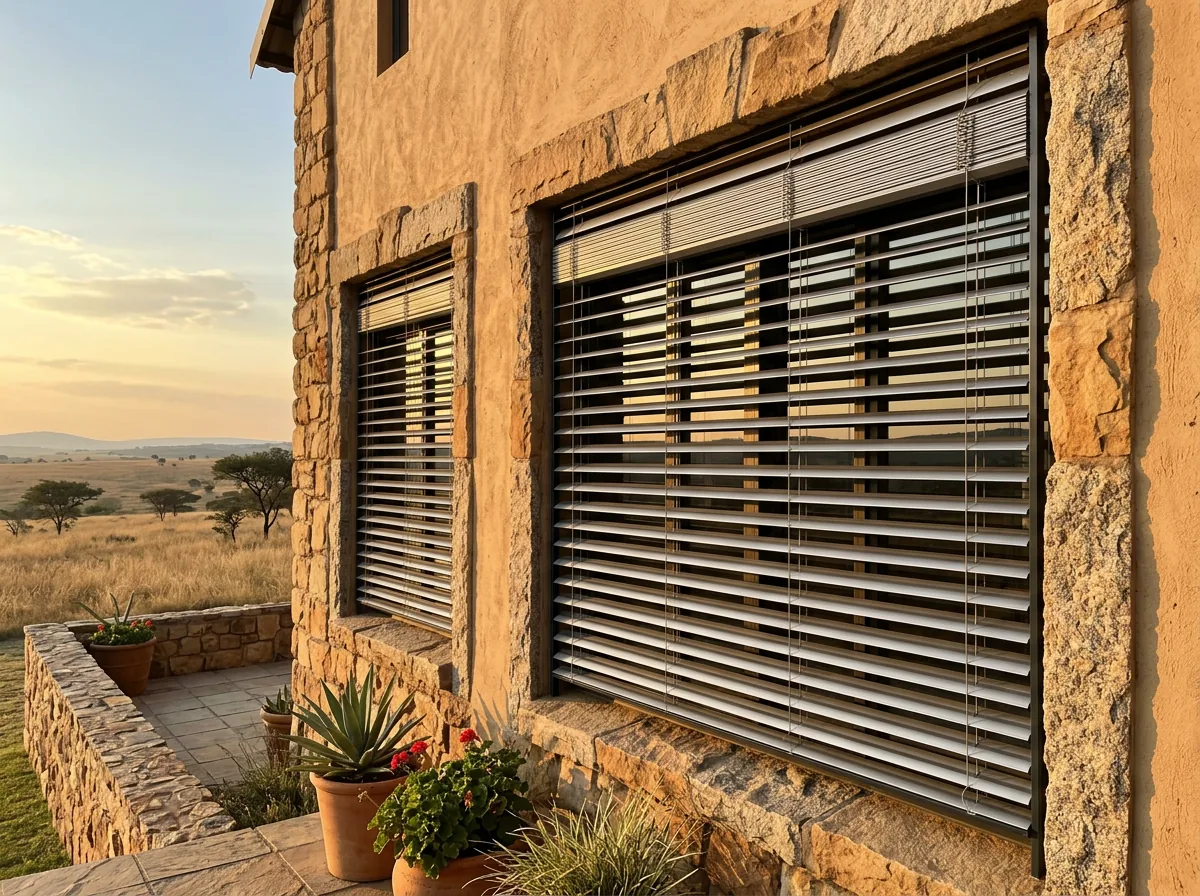
External venetian blinds in vertical guide rails outside the glass on a west-facing wall of a country estate home, aluminium louvres tilted against a low sun
A west elevation treated outside the glass — aluminium louvres tilted to cut the beam while the view stays open beneath them.

Halfway house

Want this report marked up for your own house?

Tell us which rooms or walls are the problem and we will send this same guide back with notes written against your elevations — no visit, no phone call, no obligation.

The page itself stays free and open either way. Nothing here is behind a form.

POPIA: these details are used only to send you this report. They are never shared with anyone else, and asking for the report does not put you on a call list.

The specification

What we would fit, and the catch with each

Six recommendations, each with the reason it beats the obvious alternative — and the honest trade-off the other way. Tap "Add to my enquiry" and it travels to the form.

West and north-west elevations

External venetian blinds

On the wall that takes the four o'clock sun, external venetians beat an interior blockout roller on physics: louvres outside the glass stop the beam before it reaches the pane, while an interior blind absorbs that heat on the room side and radiates it back at you. Tilted almost shut against a low sun, they still leave you a slice of paddock view.

The trade-off, honestly: a considerably bigger investment per window, living outside through storm season on a wall that has to take a real fixing — so on an exposed corner, motorise it with a wind sensor.

Paddock-facing living rooms

Sunscreen roller blinds

Where the point of the room is the view over grazing land, a sunscreen roller is the right answer inside: one flat sheet of open-weave fabric on a tube, cutting glare and ultraviolet while you carry on seeing the paddocks through it. Blockout beats it on heat and on darkness, but takes the view away entirely.

The trade-off, honestly: it manages glare, not heat, and it works one way — you see out by day, people see in at night. Facing a driveway, plan a blockout for the evening too.

Bedrooms, east and north

Blockout roller blinds

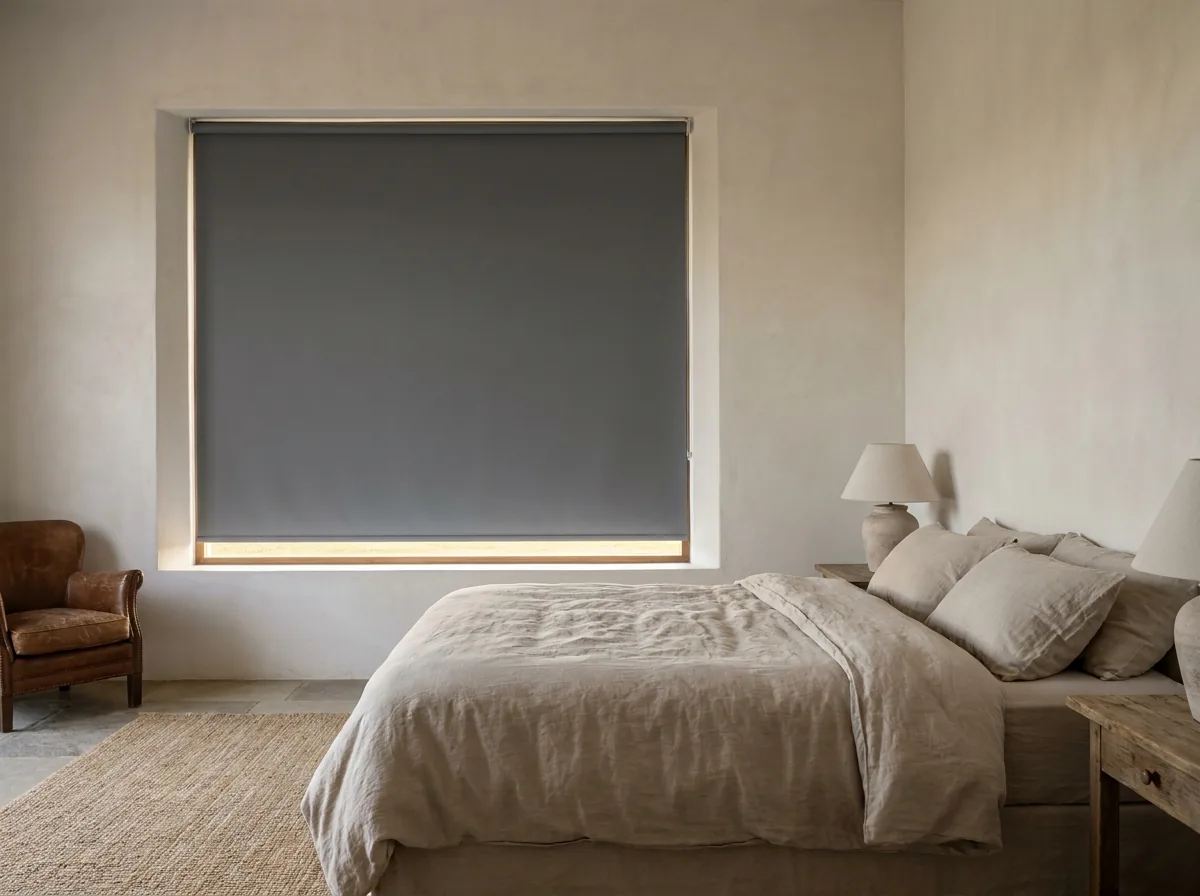
In bedrooms a blockout roller beats a venetian nine times out of ten. A venetian has a slat gap at every rung, and on an east wall taking a 6am beam those gaps become bright bars across the bed. A blockout is one uninterrupted sheet.

The trade-off, honestly: inside the reveal, any blind leaves a few millimetres of light down each side — geometry, not workmanship. Face-fixing closes that but sits proud of the frame; we look at your reveal and say which way we would go.

Rooms used at both ends of the day

Cellular honeycomb blinds

A study or nursery that is hot at three and cold at seven is the case for cellular fabric: the honeycomb traps still air against the glass and works both ways — and with an average January afternoon near 28 °C against a July night near 5 °C, both ways matter.

The trade-off, honestly: no tilt, so you are choosing temperature control over view control — on a picture window, pair it with something else.

The veranda and the entertainment deck

Folding-arm awnings, with zip screens on the windward side

For a stone veranda a folding-arm awning is the honest choice: shade over the furniture with no posts in the sightline, retracted away in winter when you want the sun back. Where the late sun comes in sideways under the fabric, a zip screen closes that face without walling in the view.

The trade-off, honestly: an awning is a shade product, not a storm shelter, and Highveld hail peaks in the late afternoon from mid-November to February — exactly when it is out. Hence the wind sensor.

Double-volume glass and whole-house control

Concealed blind boxes and motorisation

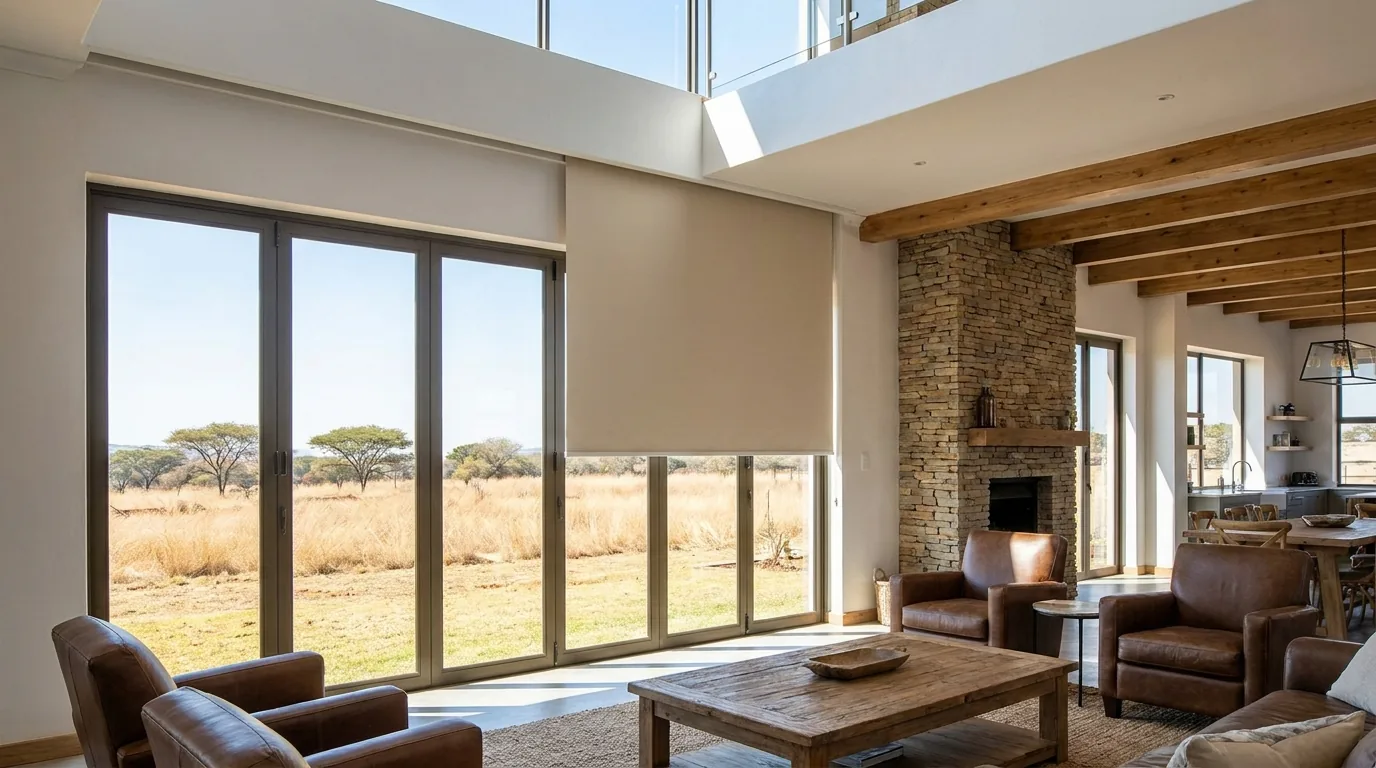
Country-house proportions bring glass walls three or four metres tall. Nobody works a chain up there, so a concealed box lets the blind live in the ceiling line and appear only when needed. Motorisation then earns its keep plainly: a sun sensor drops the west elevation before the room heats, a wind sensor pulls the awning in when nobody is home, and no cord or chain is left in the house.

The trade-off, honestly: a concealed box is far easier while a ceiling is open; motors need power routed or a battery tube charged. Rarely worth it on a small bedroom, usually worth it on a four-metre west wall.

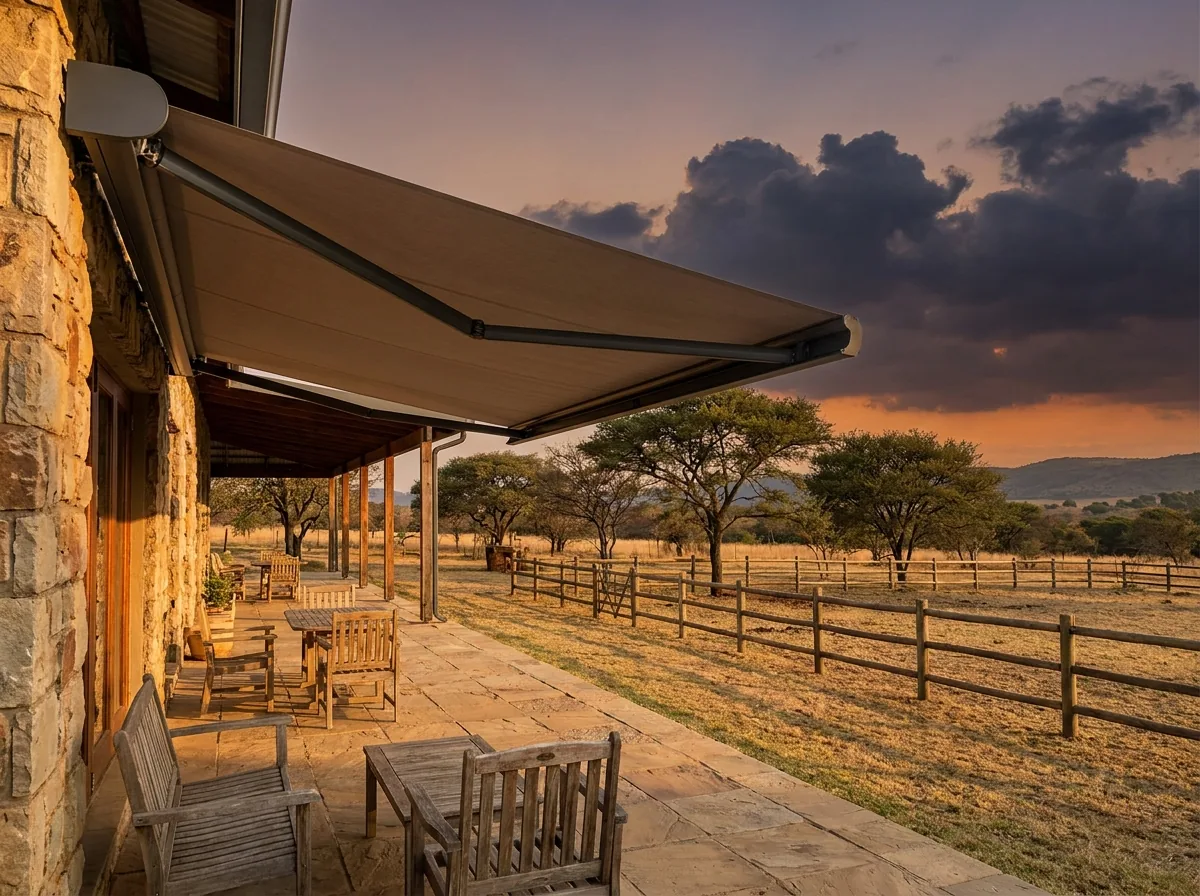
Folding-arm awning extended from a wall cassette over a stone veranda at a country estate home, paddock fencing and a Highveld storm building beyond
Folding-arm awning over the veranda — and the reason it needs a wind sensor, on the horizon.
Blockout roller blind fully lowered over a bedroom window, one flat sheet of fabric with a thin line of dawn light at the sill
Blockout roller, main bedroom — one flat sheet, and the honest line of light along the sill.

A word on roller shutters

Roller shutters shade well on stands this size: rigid aluminium slats rolling down from a headbox outside the glass, stopping heat and light before the pane. Ours are shading shutters, not security-rated shutters — a different product, which we can quote on request.

Local rules

Estate guidelines and older stands

Blue Hills Equestrian Estate publishes architectural guidelines drawn up by a team of architects, urban planners and designers — freedom of choice within a controlled environment, with owners appointing their own architect but building to the guidelines. Beaulieu, Helderfontein and the Waterfall estates run their own versions.

Practically: anything visible from outside is the estate's business — awning fabric colour, guide rails, a roller shutter headbox, the fascia it fixes to. Approval, not manufacturing lead time, is what usually delays exterior work, so we put colours and a spec sheet together for submission before anything is ordered.

On the older agricultural-holding stands the challenge is the opposite. No committee, but window sizes were set one at a time, frames are often from an earlier era, and reveals can be shallow. Not a problem — it just means standard sizes will not fit the house.

Motorised roller blind descending from a concealed recessed box in the ceiling line over a double-volume glass wall in a country estate home
Concealed box on a double-volume wall — planned into the ceiling line, so there is no headbox to see.

The limits of a web page

What we would still need to check on site

All of that is true of Blue Hills houses in general. These five decide yours, and none can be settled from here.

The reveal depth, to the millimetre

Inside the reveal or face-fixed comes down to the depth available and what the frame is made of. A cassette needing 45 mm will not go into a 40 mm reveal — and on older stands that changes window to window.

What the wall is really made of

Behind the plaster it might be solid brick, a cavity, stone cladding on blockwork or drywall on a steel frame — and a folding-arm awning puts a serious lever load on it. We tap, test-drill where sensible, and specify from what is there.

Wind exposure at that specific corner

With no neighbouring buildings, nothing breaks the wind before your veranda, and one corner is always worse than the others. That decides awning width, whether a wind sensor is essential rather than nice, and whether a zip screen is smarter there.

Where the power can come from

Motorisation is easy to want and fiddly to route: whether a cable can come in above the ceiling, whether a plug point is close enough, whether a battery tube is the answer — and on tall glass, how the ceiling is reached.

The hour that actually hurts

"The lounge gets hot" and "the lounge is unbearable from half past four in January" lead to different specifications. We would rather stand in the room when the light is bad, or see your photograph of it, than guess from a plan.

The two ways forward

Book your free expert measure

A consultant comes out with samples, measures every opening, checks the five things above, and leaves you with a written per-window quote. It costs nothing and commits you to nothing.

Would you rather have a rough number first? The ballpark tool is inside the form below — pop in whatever sizes you have and we will send a budget range by the next working day. Not sure how to measure? Leave it blank; the free measure gives you exact per-window pricing either way.

Free in-home measure and a written, itemised, per-window quote
Estate-appropriate colours and a spec sheet for submission, on request
Still deciding? Say so on the form and we will leave you in peace

Our consultant does five or six measures a week across this area, so the diary tends to fill early — worth booking ahead if you need a particular day.

What are you interested in? (tick any)
Want a ballpark figure first? Open this — about two minutes.

Blue Hills Blinds — window list

Walk the house, fill this in by hand, then type it into the form on bluehillsblinds.co.za when you get back. Measure the width first, then the drop, in millimetres.

Pop in rough sizes and we will send a budget range by the next working day. Not sure how to measure? Leave it blank — our consultant measures for free and you get exact per-window pricing either way. This is entirely optional, and nothing on it is binding.

Room Width (mm) Drop (mm) Inside or outside the reveal Product Remove

Nothing on the list yet — and it stays entirely optional.

Whatever you enter here travels with your enquiry as plain text. No uploads, no third-party services, nothing stored anywhere else. If photographs would help, a consultant will simply ask for them in the reply.

POPIA: your details are used only to arrange your free in-home measure and the consultant's call-back, and are never shared with anyone else. Tell us you are still researching and we will not phone you.

Neither, for now

Just take the report

Not ready for a visit or a number? Give us the rooms and we will email this report back with notes against your own walls. That is the whole transaction.

Or keep the page: what the sun does here, what we would fit and why and what a visit settles stay free and open, with no form in the way.

POPIA: used only to send you this report, and never shared with anyone else.

Working out

Sources

Every climate, geography and estate claim above traces to one of these. Where we have reasoned rather than cited — the product arguments, mostly — we have said so in the text.

  1. Blue Hills, Gauteng — suburb of Midrand in the City of Johannesburg, coordinates 25°56′57″S 28°05′04″E (25.949°S), which is the latitude used for the sun angles. en.wikipedia.org — Blue Hills, Gauteng
  2. Blue Hills between Main Road and the N1, north of Sunninghill; "perched … on what passes for a hill in Johannesburg"; the name from the vista the hills create seen from the city; Kyalami Country Club immediately west; Country View and Kosmosdal as named pockets. sa-venues.com — About Blue Hills
  3. Blue Hills Equestrian Estate — spread over 200 hectares in the countryside district of Beaulieu, with architectural guidelines "compiled by an expert team of architects, urban planners and other designers", communal paddocks, walking and cycling trails, natural dams and indigenous trees. bheestate.co.za — About us
  4. Solar geometry for this latitude — Pretoria (25.733°S): solar noon elevation 87.7° on 21 December and 40.84° on 20 June; December sunrise azimuth 116.62° and sunset 243.35°; June sunrise 64.24° and sunset 295.76°; and the finding on how much hotter western-exposure afternoons are. Our 87.5° / 40.6° figures for Blue Hills are calculated from its own latitude and cross-checked against these. SciELO SA — Sun, shade and natural daylight in South African town planning
  5. Midrand climate — January highs about 28 °C and July nights about 5 °C; around 693 mm of rain a year; around 3,211 sunshine hours a year, August the sunniest month at about 9.8 hours a day. weather-and-climate.com — Midrand
  6. Hail hazard — events concentrate along the Highveld, which carries among the highest annual event frequencies in the country; most frequent from mid-November through February, peaking in the late afternoon (about 16:00–17:00 South African time). Natural Hazards and Earth System Sciences 23, 1549 (2023)
  7. Highveld thunderstorms — Gauteng, Mpumalanga and parts of the Free State are especially prone to intense afternoon and evening thunderstorms from October to March. flightlineweekly.com — Highveld thunderstorms
  8. Ultraviolet — "Due to its latitude, topography and cloudless skies, South Africa receives high solar ultraviolet radiation." Wright & Norval, Photochemistry and Photobiology 99:509–518 (2023)
  9. Midrand elevation — about 1,561 m above sea level, with published figures for the area ranging roughly 1,540–1,600 m depending on the point measured. elevationmap.net — Midrand

Read it, then use it

Ready to put this against your own windows?

Book the free in-home measure and get a written, per-window quote — or send rough sizes and we will come back with a budget range by the next working day.

Book your free measure